
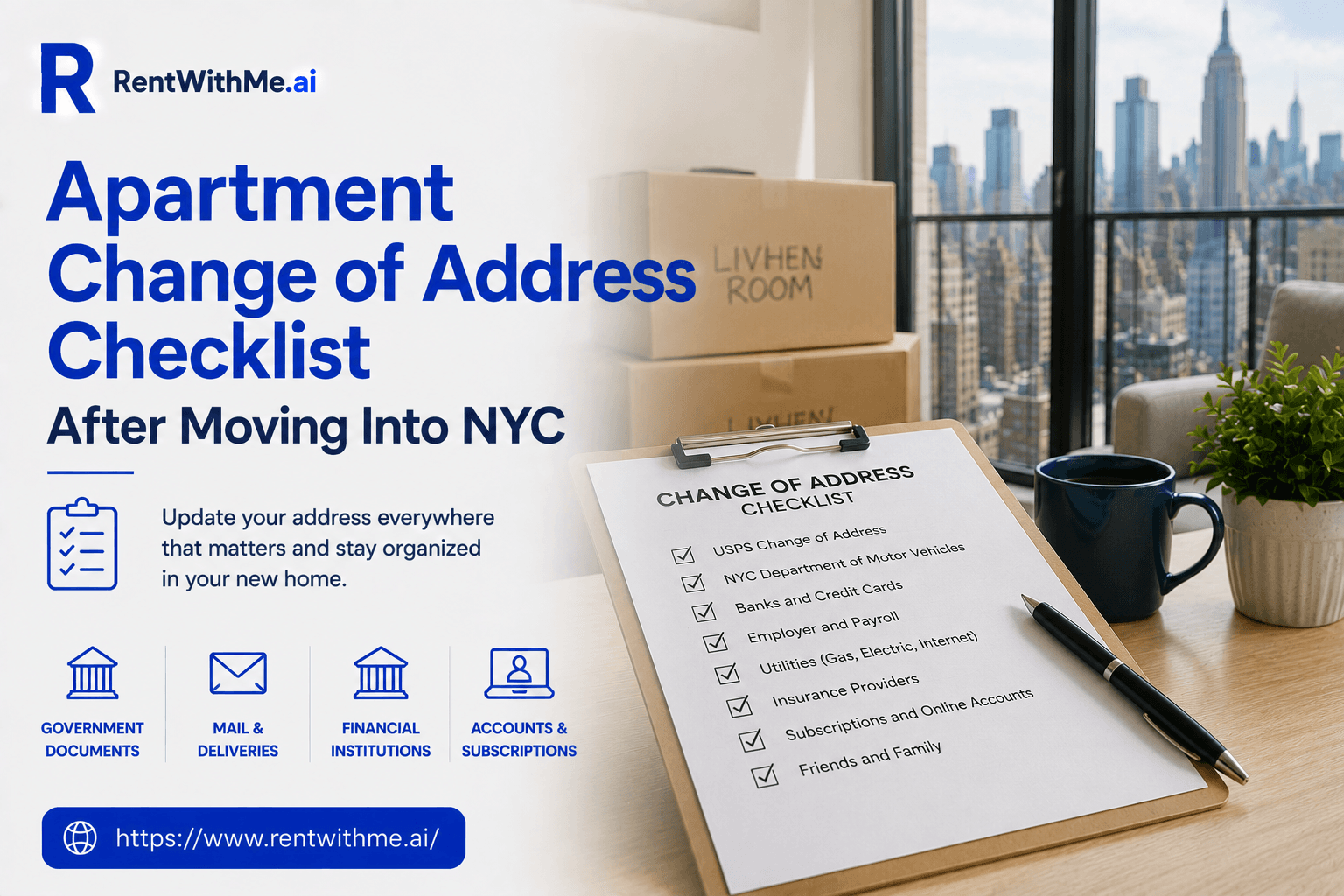
Apartment Change of Address Checklist After Moving Into NYC
Introduction
Moving into a new apartment in New York City can leave you with dozens of small administrative tasks after the boxes are unpacked. Updating your address may seem like something that can wait, but delaying it can cause missed bills, delayed government notices, problems with vehicle records, incorrect insurance information, and packages arriving at your old apartment.
A USPS change of address is an important starting point, but it does not automatically update every organization that has your information. USPS specifically notes that submitting a change of address changes your mailing information with the Postal Service, not every account associated with your old address. (USPS)
That distinction is the foundation of an organized address-change process. Mail forwarding should function as a temporary safety net while you update banks, government agencies, insurance companies, employers, utilities, subscriptions, and other important accounts directly.
Some updates are also more urgent than others. If you have a New York State driver license, learner permit, non-driver ID, or vehicle registration, New York DMV requires a permanent address change to be reported within 10 days. (NY DMV)
The easiest way to handle everything is to create one master list and work through it systematically. Instead of changing addresses randomly whenever you remember an account, prioritize official records and essential financial services before moving into less urgent subscriptions and shopping accounts.

Why Updating Your Address Quickly Matters After an NYC Move
Your address appears in far more places than most people realize.
Banks use it for statements and identity verification. Insurance companies may use location when determining coverage or pricing. Government agencies send official correspondence to addresses on file, while online retailers often save multiple shipping destinations that can easily be selected by mistake.
Moving within NYC does not remove the need to update these records.
A move from one apartment in Brooklyn to another apartment several blocks away still creates a new residential address. The same applies when moving between Manhattan and Queens, the Bronx and Brooklyn, or any other combination of NYC boroughs.
A complete address also needs the apartment number or other unit designation where applicable.
USPS advises movers to provide all necessary address elements, including the house number, street name, directional information where relevant, apartment or suite number, city, state, and ZIP Code.
For NYC apartment residents, leaving out the unit number can be particularly problematic in larger buildings.
Do Not Treat Mail Forwarding as Your Entire Address Change
One of the most common mistakes is submitting a USPS request and assuming everything else will update automatically.
It will not.
New York DMV explicitly warns that telling USPS about your move does not change the address in your DMV records. (NY DMV)
Other organizations also maintain their own databases.
Your bank does not necessarily replace its address simply because a forwarded statement eventually reaches your new home.
Your insurance company may still have the old location.
Your employer may continue sending tax documents to the former address.
The more important the relationship, the more important it is to update the organization directly.

Creating a Master Change of Address List
Before opening a dozen websites, create one master address-change list.
Divide your accounts into categories such as government, financial, employment, insurance, utilities, healthcare, shopping, subscriptions, memberships, and personal contacts.
Then mark each entry when completed.
A simple tracking table can keep the process organized:
| Category | Account or Organization | Priority | Address Updated |
|---|---|---|---|
| USPS | Immediate | ||
| Government | NY DMV | Immediate if applicable | |
| Financial | Banks and credit cards | High | |
| Insurance | Renters, auto, health | High | |
| Employment | HR and payroll | High | |
| Taxes | NY Tax and IRS where appropriate | High | |
| Utilities | Electric, gas, internet | High | |
| Building | Mailbox and intercom | High | |
| Shopping | Retail and delivery apps | Medium | |
| Subscriptions | Magazines and memberships | Medium |
This system prevents you from repeatedly wondering whether an account has already been changed.
It can also help several household members coordinate updates without duplicating work.

Search Your Old Mail for Forgotten Accounts
If you are not sure who has your old address, look through recent mail and email statements.
Review several months of physical correspondence.
You may discover organizations you rarely think about, such as retirement-plan administrators, professional associations, investment accounts, medical providers, loyalty programs, charities, or insurance policies.
Your email inbox can help too.
Search terms such as “statement,” “shipping address,” “billing address,” “renewal,” and your former street name.
This can reveal accounts that are easy to overlook.
Updating Your Address With the U.S. Postal Service
USPS should generally be one of your first updates.
For a permanent move, submit a permanent Change of Address request. USPS states that requests can be submitted online or in person at a Post Office.
USPS currently allows a Change of Address request to be submitted as early as 90 days before the effective move date and up to 30 days afterward.
If you have already moved into your NYC apartment and have not completed the request, handle it promptly.
Mail forwarding can take time to become fully effective.
USPS advises allowing up to two weeks for forwarding to begin smoothly. (USPS)
Online USPS Address Changes Include Identity Verification
If you submit the request online, expect an identity-verification process.
USPS currently states that its online Change of Address process may use mobile-phone verification and requires a valid credit or debit card. A $1.25 identity-verification fee applies to an online request, and the card’s billing address must match either the old or new address used in the request.
Be careful with websites imitating USPS address-change services.
For an official postal address change, use USPS directly rather than paying a third-party company unnecessary fees.
Understanding Standard Mail Forwarding
A permanent USPS Change of Address does not mean every piece of mail will follow you forever.
USPS states that standard forwarding generally lasts 12 months for First-Class Mail, Priority Mail, Priority Mail Express, and USPS Ground Advantage items. Periodicals such as magazines and newsletters are generally forwarded for 60 days.
USPS Marketing Mail is generally not forwarded unless the sender has provided appropriate forwarding instructions.
Certain other mail classes can also have different treatment or additional postage requirements.
This is why forwarding should be treated as a transition service rather than your permanent solution.
During the forwarding period, update the original sender whenever mail arrives bearing a forwarding label.
Understand What Happens After Standard Forwarding Ends
For permanent address changes, USPS states that during months 13 through 18, mail that would otherwise have been forwarded is generally returned to the sender with your new address attached. After 18 months, it is returned without your new address attached.
USPS also offers paid Extended Mail Forwarding.
The service can extend forwarding beyond the initial 12-month period in 6, 12, or 18-month increments, with no more than 18 months of additional forwarding.
Most renters should still focus on updating important senders directly.
Extended forwarding can provide additional protection, but it should not replace good address maintenance.

Mail Forwarding Has Important Limitations
Not every mailpiece can be forwarded.
USPS notes that mail will not be forwarded when the sender has instructed USPS to return the item if it cannot be delivered as originally addressed.
Forwarded mail may also take longer than mail addressed directly to your new home.
For important financial, legal, tax, or government correspondence, update the sender rather than relying on forwarding.
That reduces delays and keeps the organization’s records accurate.
Confirm Your New NYC Mailing Format
Before updating dozens of accounts, confirm exactly how your address should be written.
Check your lease, management records, mailbox label, or USPS address information.
Use the same apartment designation consistently.
For example, avoid using “Apt. 6B” on one account, “#6-B” on another, and omitting the apartment entirely elsewhere unless a specific system requires a different format.
Consistency can reduce delivery errors and problems with automated address verification.

Updating Your New York State Driver License or ID Address
New York’s DMV address requirement should be near the top of your checklist.
New York State law requires people with a New York driver license, learner permit, or non-driver ID to notify DMV within 10 days of a permanent address change. (NY DMV)
This applies even when you move only a short distance within New York City.
A USPS change is not sufficient.
DMV specifically states that notifying USPS does not update your DMV records. (NY DMV)
You can update the address through DMV’s available procedures, including its online services or the applicable address-change form.
You May Not Need a Replacement Physical License
Updating the DMV record does not necessarily mean you must immediately purchase a replacement card containing the new address.
DMV’s current Change of Address form states that you do not have to obtain a new license, permit, non-driver ID, or registration document simply because you updated the address, although you can request a new document if desired. (NY DMV)
The important requirement is updating the DMV’s records within the applicable timeframe.
If you want the physical document to display the new information, review DMV’s current replacement options.
Updating Vehicle Registration Records
If you own a vehicle registered in New York, do not stop after updating the address associated with your license.
DMV warns that the addresses connected with your license and individual vehicle registrations need to be addressed appropriately. (NY DMV)
When changing an address through DMV, verify which records you selected for updating.
The DMV also notes that changing one DMV address does not necessarily change every type of record maintained by the agency. (NY DMV)
Careful review is particularly worthwhile if you own multiple vehicles.

Update Auto Insurance at the Same Time
Your vehicle’s location can matter to an insurance company.
A move from one NYC neighborhood or borough to another may affect where the vehicle is primarily kept, parking arrangements, and other information relevant to your policy.
Contact the insurer directly.
Do not assume the DMV update will update insurance records.
Confirm both your mailing address and the vehicle’s garaging or residence information where applicable.
Changing Your Address With Banks and Credit Card Companies
Financial institutions should be updated early.
Start with your primary bank, savings accounts, credit cards, investment accounts, retirement accounts, and payment services.
Check both mailing and residential address fields.
Some institutions maintain a separate billing, mailing, or legal residence address.
Changing one may not automatically update the others.
Review confirmation screens carefully.
Why Financial Address Accuracy Matters
Financial institutions use addresses for more than mailing statements.
The information may appear during identity verification, replacement-card requests, tax reporting, fraud monitoring, or account recovery.
An outdated address can make routine account administration more difficult.
Electronic statements do not remove the need to update.
Even if you receive nothing by mail today, the institution may need to send a replacement card or important regulatory notice in the future.

Review Stored Billing Addresses
After changing the main account address, check saved payment methods.
A credit card’s billing address may remain connected to the old apartment in certain shopping accounts or payment profiles.
That can cause payment-verification problems. Update the card issuer first. Then review major services where the billing address has been stored separately. This becomes especially useful when cleaning up online shopping accounts later.
Updating Renters Insurance
Renters insurance is tied to the residence being insured. Do not assume a policy covering your old apartment automatically transfers to the new one. Contact the insurer before or immediately after the move and provide the new NYC address. Review the effective date carefully so you do not accidentally create a coverage gap.
The new building, neighborhood, apartment characteristics, and amount of coverage can potentially affect the policy. Use the move as an opportunity to review whether your personal-property and liability coverage still make sense.
Update Other Insurance Policies
Your renters policy is only one part of the insurance checklist.
Consider auto, life, umbrella, pet, and other policies where an address appears.
Health insurance will be covered more fully in Part 2 because provider networks and correspondence may also require review. For each policy, determine whether you are changing only the mailing address or whether the residential location affects coverage.
This distinction matters particularly for property and vehicle-related insurance.
Updating Employer, Payroll, and Human Resources Records
Your employer should receive your new address even if you work remotely and all payroll is electronic.
The address may be used for tax documents, benefits administration, employment records, emergency information, and other official purposes. Update the HR or payroll system.
If your company uses separate platforms for payroll, benefits, retirement accounts, and employee records, determine whether one change updates all systems.
Do not assume it does. A payroll application and retirement-plan provider may maintain independent records.
Remember Year-End Tax Documents
A move during the year can easily be forgotten by the time tax documents are issued.
Making the update immediately reduces the chance that a W-2 or other employment document will be sent to your previous apartment.
This becomes particularly important if you no longer have any relationship with the old landlord or incoming tenant.
Employees who change jobs near the same time as moving should also update former employers where necessary.
An organization can still need to send tax documents after you stop working there.
Updating Federal Tax Address Information
The IRS provides Form 8822 for individuals who need to notify the agency of a change to their home mailing address. (IRS)
Whether you need to file the form immediately can depend on your circumstances and other interactions with the IRS.
Do not assume a USPS change permanently updates every federal tax record.
If you are expecting a refund, notice, correspondence, or other IRS communication, keeping the tax address current becomes particularly important.
Use current IRS instructions when deciding how to report the change.
Updating Your New York State Tax Address
New York State also provides a direct way for individual taxpayers to update their information.
The Department of Taxation and Finance states that individuals can log in to an Online Services account and use the “Individual change of address” service to update a physical or mailing address. (NY State Taxation & Finance)
This is another example of why USPS forwarding is not enough.
Tax agencies maintain their own records.
If you have an active New York tax account, update it directly rather than assuming postal forwarding will solve future correspondence.
Changing Your Address With Utilities
Utility accounts should be coordinated around your actual move dates.
Electricity, gas, and other services can involve both the old and new apartments for a short period.
Make sure the old account ends on the correct date. Make sure service at the new apartment begins when needed.
Keep final statements and confirmations. If you paid a deposit or have an account credit, check how it will be handled. Do not assume an old utility account automatically transfers simply because you are staying within NYC.
Confirm What Your New Apartment Actually Requires
Before opening new utility accounts, review the lease.
Some NYC apartments include certain services in rent while tenants are responsible for others.
For example, building-provided heat does not necessarily mean every energy cost is included. Ask management when responsibilities are unclear.
Opening an unnecessary account creates administrative work, while failing to establish a required service can leave the apartment without something essential.
Updating Internet Service
Internet service deserves advance planning because provider availability can vary by building.
If you transferred an existing account, confirm that the service address now shows your new apartment.
Do not leave the billing profile associated with the former address.
If you opened a new account, close or transfer the old one according to provider instructions.
Return any equipment that belongs to the provider.
Keep receipts showing that routers, modems, or other rented equipment were returned.
Update Mobile and Other Communications Accounts
Mobile-phone providers may still have your previous billing or account address even though your phone works normally after the move.
Update the account. Do the same for any landline or other communications service you maintain.
The absence of physical mail does not mean the address is irrelevant. It may be used for billing, taxes, identity checks, emergency-service information, or future equipment orders.
Setting Up Your Mailbox Correctly
When you arrive at the new building, confirm which mailbox belongs to your apartment.
Make sure your key or access method works. Ask management how names should be displayed.
Some buildings update labels themselves. Others may have another process.
Avoid attaching unofficial labels without checking building procedures.
A correctly identified mailbox can reduce misdelivery during the first few weeks.
Check for Mail Belonging to Previous Tenants
It is common to receive mail addressed to former occupants shortly after moving into an apartment.
Do not open mail that is not addressed to you.
Follow appropriate postal procedures for misdelivered mail.
Likewise, do not expect the incoming resident at your former apartment to manage your correspondence indefinitely.
This is why direct address updates matter.
Updating Your Intercom or Buzzer
Many NYC buildings use an intercom, buzzer, virtual doorman, or mobile entry system.
Make sure your information is correctly connected to the apartment.
Test the system. If visitors can search residents by name, determine whether management needs to update the directory. If entry calls route to a mobile number, verify that the correct number is registered.
An incorrect intercom profile can interfere with visitors, food delivery, maintenance access, and packages.
Update the Building Directory
Some apartment buildings maintain lobby directories or front-desk resident databases.
Ask whether any action is required from you.
This is particularly useful in larger buildings where delivery drivers or visitors depend on resident information to find the correct unit.
If you prefer not to have your full name publicly displayed, ask management about available options.
Privacy and delivery convenience need to be balanced according to your preferences and building procedures.
Confirm Package Delivery Procedures
Your new address is only part of receiving packages successfully.
You also need to understand where packages go.
Ask whether the building uses a package room, front desk, lockers, lobby shelves, or direct apartment delivery.
Check whether your phone number or email must be registered for package notifications.
If the building has a specific delivery entrance or instruction, save that information.
You will need it when updating shopping and food-delivery applications.
Common Address Change Mistakes New NYC Renters Make
The biggest mistake is assuming USPS forwarding updates everything.
It does not. Another common problem is updating the street address while forgetting the apartment number.
In a large NYC building, that omission can be enough to delay or misdirect mail and deliveries. Some renters also change their shipping address but forget their billing address. Others update their bank but forget credit cards issued by different institutions.
Forgetting DMV’s 10-Day Requirement
For eligible New York DMV records, delaying an address update can create a compliance issue.
New York requires permanent address changes to be reported to DMV within 10 days for applicable licenses, permits, non-driver IDs, and registrations.
Do not assume USPS mail forwarding automatically satisfies this separate legal requirement.
Handle the DMV update independently and confirm which records were successfully changed afterward.
Keeping the Old Address in Auto-Fill
Modern phones and browsers make online checkout easier by storing frequently used addresses.
That convenience can become risky after moving if the previous address remains saved.
You may update a retailer account correctly but accidentally select the old address during checkout.
Review saved addresses on your browser, phone, and commonly used devices after moving.
Remove outdated entries when you are confident they are no longer required.
Part 2 will examine shopping, delivery, and digital address profiles in greater detail.
Forgetting Accounts That Rarely Send Mail
The accounts most likely to be forgotten are often those you use infrequently.
An investment account may send only one tax document or annual statement each year.
A professional association might mail a renewal notice only once during the entire year.
An insurance company may communicate digitally until an important physical notice needs to be delivered.
Your master checklist should therefore include important relationships even when recent mail has been minimal.
Changing the Address but Not Verifying It
After submitting an address update, take a moment to verify that it processed correctly.
Review your next bank statement or check the address shown inside the account profile.
Confirm that the street address and apartment number both appear exactly as intended.
For important services, verification usually takes only a minute and can catch simple errors.
A transposed apartment number could send sensitive correspondence to another resident in the building.
Creating a Reliable Address-Change Routine
A strong change-of-address process should move from the most important records toward lower-priority accounts.
Start with USPS and government records that carry legal or time-sensitive address requirements.
Then update financial accounts, insurance, employment, taxes, utilities, internet service, and building systems.
After completing those essentials, continue through healthcare, voting records, subscriptions, shopping accounts, memberships, delivery apps, and other everyday services.
Keep your master checklist available throughout the entire process rather than deleting completed organizations.
Mark each organization as completed so you retain a clear record of every successful update.
Preparing for the Next Round of Address Updates
By this stage, the essential framework of your new address should already be taking shape.
Mail forwarding has been established, and applicable New York DMV records should now reflect your move.
Banks, credit cards, insurance, employment, tax records, utilities, internet service, and building systems should also be receiving attention.
The remaining accounts may appear less urgent but can still create meaningful problems when forgotten.
Healthcare records can affect correspondence, billing, insurance administration, and other important parts of medical care.
Voter registration should reflect your current residence, while shopping apps can accidentally send costly orders to your former apartment.
Subscriptions, memberships, schools, childcare providers, licenses, emergency contacts, and browser auto-fill settings may also still contain outdated information.
Part 2 continues through these everyday categories while focusing on address updates NYC residents commonly overlook.
Updating Health Insurance After Moving Into NYC
Healthcare information can be easy to overlook because people usually associate address changes with ordinary mail.
Your address can still affect insurance correspondence, pharmacy records, provider access, billing information, and important notices.
Start with your health insurance account and confirm both the residential and mailing addresses listed.
If you moved into NYC from another state or another part of New York, check whether your provider network changes.
A healthcare provider that was convenient before moving may now be far away or outside your plan’s preferred network.
Do not automatically replace your existing doctors simply because your residential address changed.
First confirm whether your current providers remain accessible and covered, then decide whether closer care would be more practical.
Updating Medicaid and Public Health Coverage
Address accuracy becomes particularly important for renters who receive Medicaid or similar public health coverage.
New York State specifically warns that Medicaid mail cannot simply be relied upon through ordinary forwarding.
Updating your address only with the Post Office therefore may not ensure important Medicaid notices reach you.
If your coverage is managed through NY State of Health, update the address connected with that account.
If coverage is administered by a local social services agency, follow the appropriate address-change process directly.
NYC residents whose Medicaid cases are managed locally generally work through the city’s Human Resources Administration.
The correct procedure can depend on how your individual Medicaid case is currently administered.
Moving across county lines can make accurate address reporting especially important for certain Medicaid recipients.
Follow current New York State guidance and notify the appropriate office when your residential location changes.
Update Doctors and Other Healthcare Providers
Next, review the healthcare professionals and practices that you currently use on a regular basis.
This may include primary care, dentistry, optometry, specialists, therapy, physical therapy, and other medical providers.
Many practices allow patients to change contact information through an online patient portal.
Others can update the information by telephone or during an upcoming scheduled appointment.
Confirm more than the street address while reviewing your healthcare information.
Check your phone number, email address, insurance details, emergency contact, and preferred pharmacy as well.
Moving provides a useful opportunity to correct several outdated healthcare details at the same time.
Update Your Pharmacy
A pharmacy account can contain your residential address even when prescriptions are normally collected in person.
Update the address so the pharmacy’s records accurately reflect your current residence.
If your previous pharmacy is now inconvenient, consider transferring routine prescriptions to a location closer to home.
People who receive prescriptions through delivery or mail should treat this update as especially important.
You do not want medication sent to your former apartment because an outdated delivery address remained active.
Changing School, College, and Childcare Records
Families and students may have several education-related records that require an address update after moving.
Schools can use residential addresses for official correspondence, emergency records, eligibility, transportation, and administrative purposes.
Contact the appropriate school or program office instead of assuming information updates through another government system.
If children are moving to a different school, the process may involve more than changing contact details.
Enrollment, residency verification, or related documentation may also need to be reviewed and updated.
Update Emergency Contact Information Too
When updating a child’s address, review the emergency contact information stored in school records.
A move may change which relative, neighbor, caregiver, or trusted friend can respond quickly during an emergency.
The same principle applies to daycare providers, after-school programs, and other childcare arrangements.
Review authorized pickup details, billing addresses, transportation instructions, and parent contact information at the same time.
Updating only the street address can leave other important records unnecessarily outdated.
College Students Should Review Multiple Systems
Colleges and universities often maintain several different address fields within their student information systems.
A portal may contain permanent, local, mailing, billing, and emergency-contact addresses separately.
Review every relevant field instead of assuming that changing one automatically updates the others.
If you expect transcripts, refunds, financial documents, identification cards, or other mailed items, confirm the selected destination.
Students receiving financial aid should also review whether related systems require separate address updates.
Updating Government Benefits and Assistance Records
If you receive government assistance, your address should be treated as a high-priority record after moving.
Eligibility, renewal, verification, or appointment notices may depend on information stored by the administering agency.
Review each program separately rather than assuming that one government address change updates every account.
Different programs can operate through separate databases, departments, and administrative systems.
Do Not Depend on USPS for Benefit Notices
Mail forwarding remains useful, but it should never become your only strategy for government benefits.
The Medicaid example is particularly important because New York State specifically states that Medicaid mail cannot be forwarded.
For any benefit you receive, update the residential address directly with the organization administering the program.
Keep confirmation whenever the agency provides one after completing the change.
If an online account displays your new address, save a screenshot until processing appears complete.
Updating Voter Registration After Moving in NYC
Your residential address affects voting because it determines which districts and contests apply to you.
The NYC Board of Elections advises voters who move to update their registration information promptly.
Even a relatively short move within the city can potentially place you in another election district.
Do not assume remaining inside the same borough means your voter registration information can stay unchanged.
How to Change Your Voter Registration Address
New York State allows registered voters to update residential information through approved voter registration processes.
NYC also provides an online voter registration system for eligible city residents.
These systems can be used to register initially or update the address associated with an existing registration.
Additional electronic options may also exist for eligible residents holding qualifying New York identification.
After submitting the change, verify the registration instead of assuming processing occurred successfully.
The NYC Board of Elections provides tools that allow voters to confirm current registration information.
Pay Attention to Election Deadlines
Address changes become especially important when a primary, special, or general election is approaching.
Election processing deadlines can affect whether updated information is reflected in time for a specific election.
Use current Board of Elections guidance rather than relying on an old moving checklist or remembered deadline.
Election dates and registration deadlines can change depending on the election cycle and applicable rules.
Review current official information whenever your move occurs close to an upcoming election.
Updating Immigration Records When Applicable
For certain non-U.S. citizens, moving can create separate federal address-reporting responsibilities that require attention.
USCIS guidance states that many non-U.S. citizens must report qualifying address changes within required timeframes.
Do not assume that filing a USPS Change of Address automatically updates your USCIS records.
Postal forwarding does not replace the applicable immigration address-change process.
USCIS provides procedures for updating addresses, including for certain pending or recently approved applications.
Because immigration circumstances differ substantially, follow current instructions that apply specifically to your status and cases.
If other immigration agencies or courts are involved, separate notification requirements may also apply.
Updating Professional Licenses
Professionals working in regulated fields should check whether their licensing authority keeps an address on file.
Doctors, nurses, real estate professionals, accountants, attorneys, contractors, and other licensed workers may face different requirements.
Do not assume that updating your employer’s HR system automatically updates your professional licensing record.
Those systems are separate and may require different procedures.
Visit the authority responsible for your credential and review its current address-change requirements.
Some professional databases separate private mailing information from details that appear publicly.
Review available privacy options before submitting changes when public disclosure could be relevant.
Updating Business and Freelance Records
Freelancers and business owners may have work-related addresses stored across many different systems.
These can include registrations, tax accounts, payment processors, banks, business cards, insurance, directories, and invoicing platforms.
First determine whether your old residential address was also being used as a business address.
If it was, identify every service or document where the former apartment still appears.
Pay particular attention to publicly searchable directories and business profiles.
You may not want your new residential apartment automatically displayed online simply because the old one was.
Update Invoices and Payment Information
If your invoices display a mailing or business address, update the template before sending future documents.
Review accounting software because older templates may continue showing outdated information after the main account changes.
Check payment processors separately because tax, verification, customer-facing, and billing addresses may be stored independently.
Updating one field does not always change every address connected with the same business account.
Updating Online Shopping Accounts
Shopping accounts are among the most common places where old addresses continue causing problems.
People update important financial accounts but forget that many retailers still store the previous apartment.
During checkout, the old address can appear automatically and be selected without much attention.
By the time the error is noticed, the order may already be processing for shipment.
Review Your Most Frequently Used Retailers First
Start with the online stores and retailers you use most frequently.
Check the default shipping address and remove the old location when it is no longer necessary.
Then review stored payment information because the associated billing address may also need updating.
Your account should show the new NYC apartment as the correct default before another purchase.
Check Recurring Deliveries
Recurring deliveries deserve extra attention because they may process without requiring a new checkout each time.
Review pet supplies, household products, personal care items, meal services, coffee deliveries, and similar subscriptions.
Update the shipping destination before the next scheduled processing or fulfillment date.
Do not assume that changing the primary account address also changes every existing recurring order.
Open each active subscription and confirm the delivery address directly.
Updating Food Delivery and Grocery Apps
Food and grocery delivery applications can be especially sensitive to small address mistakes in NYC.
Two buildings may sit close together, but sending a driver to the wrong entrance creates unnecessary delays.
Update the complete address and include the correct apartment number wherever appropriate.
Review delivery instructions and remove references that applied only to your former building.
Instructions such as “leave with doorman” become useless if your new building has no doorman.
Rewrite Delivery Instructions for the New Building
Effective delivery instructions should remain short, accurate, and useful for the person making the delivery.
If the building has multiple entrances, clearly identify which one should be used.
If an intercom requires a name, provide only the legitimate information necessary for building access.
If deliveries should go to a package desk or designated room, follow management procedures.
Avoid long instructions containing unnecessary details that make the directions harder to understand.
Delivery workers benefit most from clear information they can process quickly.
Check the Map Pin
Some delivery platforms rely on a map pin in addition to the written address.
Confirm that the pin identifies the correct building and appropriate side of the property.
This can be especially helpful in large complexes or buildings with entrances on another street.
Navigation systems may sometimes identify the wrong entrance even when the typed address is correct.
Check this before placing an important order that depends on accurate timing.
A low-stakes delivery can reveal problems before you urgently need groceries or another essential order.
Updating Subscription Services
Subscription services are easy to forget because many communicate almost entirely through email.
Prioritize subscriptions that still ship physical products or printed materials to your home.
Magazines, newspapers, boxes, food deliveries, pet supplies, and beauty products all require the correct address.
Digital subscriptions may also maintain a billing address for payment or taxation purposes.
Check Annual Memberships
Annual memberships are especially easy to overlook because you may not interact with them frequently.
Professional organizations, clubs, museums, roadside services, and warehouse memberships may still store the old apartment.
Review services that renew annually or send occasional membership materials through the mail.
Updating them now is easier than remembering after an important card or notice goes elsewhere.
Updating Mobile Phone Billing Information
Your mobile number usually follows you after moving, but the billing address may remain unchanged.
Update the carrier account and review both service and billing addresses if separate fields exist.
This is also a useful opportunity to check any emergency-address information tied to specific services.
Follow the carrier’s instructions for features that depend on residential or location information.
Do not assume your phone’s GPS automatically updates the billing information stored inside the account.
Updating Streaming and Digital Services
Streaming services may seem unrelated to moving, but many still maintain billing-address information.
Review major paid accounts, especially when the payment card associated with them also changed.
A billing mismatch may not create an immediate problem, but consistent information reduces future complications.
The same principle applies to software subscriptions, cloud storage, gaming, and digital publications.
You do not need to update every free website or inactive account immediately.
Prioritize services involving payments, identity, important records, or physical deliveries.
Updating Friends and Family
After essential official accounts are updated, tell trusted people who genuinely need your new address.
There is no need to post the information publicly or share it more broadly than necessary.
Send the new address privately to close relatives, friends, and people likely to mail something.
Ask regular senders to remove the previous address from their saved contacts.
That simple update can prevent old-address mistakes several months after your move.
Review Emergency Contacts
Moving is also a useful time to review the address information held by emergency contacts.
If a trusted person keeps your home address, provide them with the new location.
Parents should update caregivers, while pet owners may want to notify emergency pet-care contacts.
People living alone may especially benefit from ensuring someone trusted knows the correct building and apartment.
Updating Pet-Related Records
Pet owners often have several additional accounts and records that contain residential address information.
These may include veterinarians, pet insurance, microchip databases, licensing records, walkers, sitters, and boarding facilities.
Microchip information deserves particular attention because accurate contact details support reunification if a pet is lost.
Review both the residential address and telephone information stored in the relevant pet profile.
If you changed veterinarians, request appropriate records so the new provider can continue care effectively.
Updating Fitness and Recreation Memberships
If you belong to a gym or fitness studio, update billing information connected with the account.
When your previous location becomes inconvenient, check whether the membership can transfer to another nearby branch.
Do not automatically cancel before reviewing the membership terms and possible transfer options.
Some chains allow access across several NYC locations, while others use location-specific agreements.
Review the contract before making changes that could create avoidable fees.
Updating Loyalty and Rewards Accounts
Airline, hotel, grocery, retail, and other rewards programs can retain old addresses for years.
These accounts are lower priority than financial or government records but still deserve eventual review.
Focus first on programs containing valuable rewards, points, status, or stored benefits.
Accurate contact information may matter if the account later requires verification or replacement materials.
You do not need to finish every rewards program during your first week after moving.
Place lower-priority accounts into the final section of your master checklist.
Removing the Old Address From Browser Auto-Fill
Browser auto-fill can easily reintroduce an old address after you thought every account was updated.
Chrome, Safari, Edge, Firefox, and other browsers may maintain address information separately from retailer accounts.
Review the saved addresses on browsers you regularly use for shopping or form completion.
Set the new NYC apartment as the appropriate current address.
Remove the previous address once you are confident it is no longer necessary.
Check multiple devices if saved information does not synchronize automatically between them.
Check Your Phone’s Contact Card
Phones often use a personal contact card when suggesting addresses across different applications.
Navigation, browsers, calendars, voice assistants, and other services may use information stored there.
Update the home address inside the relevant personal contact profile.
Then test a simple navigation command directing the phone to “Home.”
If it still selects your former apartment, another saved location probably remains unchanged.
Update Navigation Apps
Google Maps, Apple Maps, Waze, and other navigation applications may store a separate Home location.
Update that location so routine navigation directs you toward the correct apartment.
This becomes especially useful when you are tired and automatically select a saved destination.
Saved locations can also influence commute estimates and location suggestions throughout other applications.
If your workplace changed as part of the move, update the saved Work location too.
Reviewing Digital Wallets and Payment Profiles
Digital wallets can maintain shipping or billing information separately from your primary banking account.
Review any address information stored directly inside the wallet or payment profile.
Some retailers may pull delivery details from the wallet instead of the retailer’s own account.
One outdated wallet profile can therefore create address mistakes across several different websites.
Correcting the stored source can be more efficient than fixing individual orders after they are placed.
Checking Ride-Hailing Apps
Ride-hailing applications may continue storing your former apartment as a saved Home location.
Update the address and review any saved pickup instructions connected with the old property.
If your previous building required side-street pickup, those instructions may confuse drivers at your new location.
Pay close attention to the exact pickup point shown on the map.
In dense NYC neighborhoods, the wrong side of an avenue can create unnecessary delays.
Managing Packages in Your New NYC Building
Successful package delivery depends partly on understanding how your new building receives and stores deliveries.
Ask management or front-desk staff where packages are normally accepted.
Some properties use staffed package rooms, while others provide lockers or another centralized system.
Smaller buildings may leave packages in a lobby or require direct delivery arrangements.
Learn the process before placing several online orders at once.
Understand Package Notification Procedures
Find out whether the building sends package notifications by text, email, application, or another method.
If registration is necessary, complete it before relying heavily on deliveries.
Make sure your name and apartment information match the building’s resident records accurately.
A parcel addressed to an unfamiliar nickname could create confusion when staff cannot identify the resident.
Use a consistent recipient name whenever practical to make deliveries easier to process.
Consider Delivery Security
Package theft is a concern in many cities, including New York.
Do not assume the lobby is secure simply because the building has a locked entrance.
If your building offers lockers or a staffed package room, learn how to use them.
For expensive items, consider available signature or secure-delivery options when appropriate.
Avoid leaving valuable packages unattended longer than necessary.
Updating Building Access Information
Modern NYC apartment buildings increasingly use digital access systems.
Your new building may have a mobile app for doors, elevators, visitors, maintenance, amenities, packages, or intercom functions.
Complete your resident profile.
Verify your phone number and email address.
Make sure the correct apartment is associated with your account.
If you share the apartment with another adult, determine whether each resident needs a separate profile.
Update Emergency Information With Management
If management maintains emergency contact information, review it.
Provide accurate contact details according to building procedures.
This can be useful during maintenance emergencies or building-wide issues.
Do not assume the information from your rental application automatically became the final resident profile.
Ask if anything else is required after move-in.
Questions to Ask Your New Building Management
A short conversation with management can prevent several weeks of confusion.
You do not need to ask questions already answered clearly in the lease or resident handbook, but you should understand the building’s everyday systems.
Useful questions include:
- How should my name appear on the mailbox or intercom?
- Where are packages delivered?
- Does the building use package lockers or a resident app?
- Are there special instructions for food and grocery deliveries?
- How do guests use the intercom?
- Who should I contact for maintenance requests?
- What are the trash and recycling procedures?
- Are there rules for large deliveries or furniture?
- Does management need updated emergency-contact information?
- How should replacement keys or access devices be requested?
Keep the answers somewhere accessible rather than depending on memory.
Building procedures become much easier once they are part of your routine.
Checking Every Address Stored on Your Devices
By this stage, your physical mail and major accounts may be updated, but digital systems can continue storing the old apartment.
Perform a quick address audit.
Search your email for the former street name.
This can reveal accounts you forgot.
Then search your password manager if it supports account notes or categories.
Review major apps on your phone.
Look particularly closely at services involving deliveries, transportation, payments, healthcare, or identity verification.
Search Your Email for the Former Street Name
This simple technique can uncover surprisingly old accounts.
Search the exact street name without the apartment number first.
Then search the complete former address.
Look at which companies have sent order confirmations, statements, appointment information, or account notices containing that address.
You do not need to update every historical email.
Use the results to identify active relationships.
Watch New Mail for the Next Several Months
Your checklist will probably miss something.
That is normal.
When forwarded mail arrives at the new apartment, treat it as a reminder.
Ask whether the sender still needs your current address.
If yes, update the account immediately rather than placing the letter aside and forgetting.
Over several months, this method catches many low-frequency accounts that were absent from your original checklist.
Keeping Your Address Private While Updating Accounts
A change of address does not mean your new apartment needs to become publicly searchable.
Give the information to organizations that legitimately require it.
Be more cautious with public directories, social media profiles, professional websites, and online marketplace listings.
If an account offers separate public and private contact information, understand which address will be displayed.
This is especially relevant for freelancers and business owners who previously used a home address for public business listings.
Do Not Post Your Full New Address Publicly
Sharing a photo celebrating your new apartment is different from publishing your complete unit address.
Consider what information is visible in social posts.
Building numbers, unit numbers, lease paperwork, package labels, keys, and access information can reveal more than intended.
Share the address privately with people who need it.
There is rarely a reason to announce the full apartment address publicly.
Creating a Second-Round Address Audit
After the major changes are complete, schedule a second review rather than assuming the project is finished.
A useful approach is to revisit your master list after several weeks.
Look for accounts that still display the old address.
Check forwarded mail.
Review recent purchases.
Confirm that important government and financial records show the correct information.
This second audit catches mistakes made during the hectic days surrounding the move.
Separate Completed and Unverified Updates
There is a difference between submitting a change and confirming that it worked.
Your tracking system can reflect that.
For example:
| Status | Meaning |
|---|---|
| Not Started | Address still needs to be changed |
| Submitted | Change was requested but not yet verified |
| Confirmed | Account displays the correct new address |
| Not Applicable | No address change is required |
This small distinction can be valuable for high-priority records.
A confirmation page does not always mean every related account or service was updated.
Preparing for the Final Address-Change Review
At this point, the new NYC address should be established across most of your daily life.
Your healthcare and insurance records have been reviewed.
Schools and childcare providers have been considered.
Government benefits have been checked.
Voter registration has been addressed where applicable.
Professional, business, shopping, delivery, subscription, mobile, and digital accounts have been reviewed.
Your devices should also be learning that “Home” now means the new apartment.
Packages should have a reliable destination.
Building management should have the information needed for your mailbox, intercom, deliveries, and resident profile.
There is still one important stage remaining.
Part 3 will bring everything together with real-life NYC renter scenarios, frequently asked questions, a comprehensive change-of-address checklist, commonly forgotten accounts, strategies for tracking completed updates, privacy and identity-protection considerations, packages or mail sent to the wrong address, moves between NYC boroughs, roommate and family situations, mistakes to avoid, and a final system for confirming that your old apartment has disappeared from the accounts that matter.
Real-Life Change of Address Examples for NYC Renters
A checklist becomes easier to use when you can see how it applies to an actual move. Not every renter needs to update the same organizations, and the order of priority changes depending on employment, vehicle ownership, family circumstances, benefits, and how many services are connected to the old address.
The most useful approach is to identify the records that could create a legal, financial, healthcare, security, or delivery problem if they remain incorrect. Handle those first, then work through lower-priority accounts over the following weeks.
Moving From One Manhattan Apartment to Another
Consider a renter moving from an Upper East Side apartment to a new home downtown. Because both residences are in Manhattan, it may feel as though very little administrative information has changed.
The street address, however, has changed completely. USPS forwarding should be established, and financial institutions, insurance companies, employers, utilities, shopping accounts, and other important services still need the new information.
If the renter has a New York State driver license or other applicable DMV record, the permanent address change must also be reported to DMV within the required timeframe. Remaining in the same borough does not eliminate that responsibility.
Voter registration deserves attention too. A relatively short NYC move can affect the election districts associated with a residence, so the voter should update the address rather than assuming the previous registration remains appropriate.
Moving From Brooklyn to Queens
A borough-to-borough move makes the need for an address audit even clearer.
The renter should update the same major categories discussed throughout this guide, including USPS, government records, financial accounts, employment information, insurance, utilities, healthcare, deliveries, subscriptions, and voter registration.
Daily-life accounts also deserve review.
The saved “Home” location in navigation and ride-hailing apps should change. Food delivery instructions should reflect the new building, and recurring shopping orders need to be checked before their next shipment.
If the renter owns a vehicle, DMV and auto insurance records deserve particularly prompt attention.
The new location may also affect parking habits, commute patterns, and where the vehicle is regularly kept.
Moving Into NYC From Another State
An interstate move can require more than a standard change of mailing address.
A renter arriving from another state may need to determine what New York requirements apply to a driver’s license, vehicle registration, insurance, taxes, voter registration, healthcare coverage, professional licensing, and other records.
Do not treat an interstate move as simply changing the address printed on existing accounts.
Some records may require a new registration, transfer, enrollment, or application rather than a basic address edit.
Use the current official instructions from the relevant New York agency for each requirement.
Deadlines and documentation requirements can differ significantly depending on the record involved.
Moving With a Family
Families often have the longest change-of-address lists.
In addition to the adults’ financial, employment, government, and insurance records, parents may need to update schools, childcare providers, pediatricians, dentists, pharmacies, activity programs, emergency contacts, and accounts associated with children’s services.
Divide the work between adults where practical.
One person might handle financial and utility accounts while another manages school, healthcare, and family records.
Keep one shared checklist so both people know what has been completed.
This prevents the same account from being updated twice while another important record is forgotten entirely.
Moving With Roommates
Roommates should generally manage their own personal address changes.
A USPS change submitted by one person should not be treated as a substitute for every roommate handling their individual mail and accounts appropriately.
Shared services require coordination.
Internet, electricity, renters insurance arrangements, subscriptions, and other joint household services may be registered in one roommate’s name.
Decide whether those accounts are being transferred, closed, or replaced.
At the new apartment, confirm that all residents who need access are properly included in the building’s intercom, package, or access system.
Frequently Asked Questions About Changing Your Address After Moving
Address changes sound simple until individual situations arise.
Renters often discover that “changing an address” can mean several different things depending on whether the organization needs a residential address, mailing address, billing address, service address, or shipping destination.
Is Changing My Address With USPS Enough?
No.
USPS forwarding helps redirect eligible mail, but it does not automatically update your records with every organization.
You still need to contact important senders directly.
Banks, insurers, government agencies, employers, healthcare organizations, utilities, subscriptions, and other account providers may maintain independent records.
Use mail forwarding as a safety net while completing direct updates.
How Soon Should I Change My Address After Moving?
Complete high-priority changes immediately or within any deadline imposed by the relevant organization or law.
For example, New York DMV requires applicable New York license, permit, non-driver ID, and registration address changes to be reported within 10 days of a permanent move. (dmv.ny.gov)
Other updates may not have the same deadline but can still cause problems if delayed.
Financial accounts, insurance, employers, utilities, tax records, healthcare, and important deliveries should generally be handled early.
Does USPS Forward All Mail?
No.
Different mail classes and sender instructions can affect whether an item is forwarded.
USPS explains that permanent Change of Address forwarding generally covers First-Class Mail and several other eligible services for 12 months, while periodicals are generally forwarded for 60 days. (faq.usps.com)
This is another reason to update senders directly.
You should not assume every important piece of correspondence will automatically find you.
What If I Forgot to Submit USPS Forwarding Before Moving?
Submit the request as soon as possible.
USPS currently permits a Change of Address request to be submitted up to 30 days after the effective move date, although earlier submission provides a smoother transition. (faq.usps.com)
Meanwhile, directly update organizations that might send important mail.
Do not wait for forwarding to become active before correcting your bank, insurance, government, employment, or other essential records.
Do I Need to Change My Address If I Move Within the Same NYC Building?
If your apartment number changes, your address has changed for delivery purposes even though the building’s street address remains the same.
Update records that contain the unit number.
This is especially important for USPS-related mail, packages, deliveries, building systems, financial correspondence, and government records requiring your current residence.
Do not assume a mail carrier or front desk will automatically know you moved from one unit to another.
Do I Need to Update Accounts That Use Paperless Billing?
Usually, yes, when the organization maintains your residential or mailing address.
Paperless billing only changes how routine statements are delivered.
The company may still use the stored address for identity verification, legal notices, replacement cards, tax reporting, account recovery, or other purposes.
Electronic communication does not make an incorrect address harmless.
Should I Keep My Old Address Saved in Shopping Accounts?
Once you no longer need it, removing it can prevent accidental orders.
This is particularly useful for default shipping profiles, browser auto-fill, digital wallets, grocery applications, and recurring deliveries.
If you temporarily retain the old address for a legitimate reason, make the new apartment the default.
Review the destination every time you place an order during the first few weeks after moving.
Complete NYC Apartment Change of Address Checklist
The following checklist brings the major categories together. Not every item applies to every renter, so treat it as a master reference rather than a list that everyone must complete identically.
- Submit the appropriate USPS Change of Address request.
- Verify your complete new mailing address and apartment number.
- Update New York DMV records when applicable.
- Review vehicle registration records.
- Update auto insurance and vehicle location information.
- Update banks and savings accounts.
- Update credit cards.
- Update investment and brokerage accounts.
- Update retirement accounts.
- Review payment-service profiles.
- Update renters insurance.
- Review other insurance policies.
- Update employer HR information.
- Update payroll records.
- Update employee benefits systems where necessary.
- Update former employers if they may still send tax documents.
- Review IRS address information.
- Update New York State tax records where appropriate.
- Transfer or establish electricity and other required utilities.
- Update internet service.
- Update mobile carrier billing information.
- Confirm your building mailbox information.
- Update intercom or buzzer information.
- Register for the building’s resident or access application if required.
- Confirm package-delivery procedures.
- Update health insurance.
- Update Medicaid or other benefit records when applicable.
- Update doctors and specialists.
- Update dental and vision providers.
- Update pharmacies and prescription-delivery addresses.
- Update schools, colleges, or universities.
- Update childcare providers.
- Review children’s emergency-contact information.
- Update government assistance programs when applicable.
- Update voter registration.
- Address applicable immigration reporting requirements.
- Update professional licenses where required.
- Update business registrations and business accounts when applicable.
- Change invoicing and accounting profiles.
- Update frequently used online retailers.
- Review recurring merchandise deliveries.
- Update grocery-delivery applications.
- Update food-delivery applications.
- Replace old building delivery instructions.
- Verify delivery map pins.
- Update physical subscriptions.
- Update membership accounts.
- Review digital subscription billing addresses.
- Update important loyalty programs.
- Update pet insurance and veterinary records.
- Update pet microchip contact information where applicable.
- Update fitness and recreation memberships.
- Tell trusted friends and family your new address.
- Update appropriate emergency contacts.
- Change your saved Home location in navigation apps.
- Update ride-hailing apps.
- Update browser auto-fill information.
- Update your phone’s personal contact card.
- Review digital-wallet shipping and billing information.
- Remove outdated addresses from devices and applications.
- Search email for the old street address to find forgotten accounts.
- Watch forwarded mail for overlooked senders.
- Complete a second address audit several weeks after moving.
Completing this checklist in a single sitting is unnecessary.
Start with legally time-sensitive and high-consequence records, then work gradually through shopping, memberships, subscriptions, and other lower-priority accounts.
Important Accounts Renters Commonly Forget
The most obvious accounts are rarely the biggest problem.
Most people remember their bank and electric company.
It is the account used twice a year that remains attached to the old apartment for another three years.
Retirement plans are a common example.
An employee may update the company’s payroll system but forget that a separate financial institution administers a 401(k) or other retirement account.
Former employers can also be overlooked.
If you worked somewhere during the tax year, that employer may need your current information when tax documents are issued.
Medical Accounts Can Remain Dormant for Months
A specialist you visit only once a year may still have your previous address.
The same applies to dentists, optometrists, therapists, laboratories, imaging centers, and other providers.
You do not necessarily need to contact every healthcare organization immediately.
However, maintain a list and update records as you encounter them.
If an organization may send bills or sensitive medical correspondence, consider giving it higher priority.
Old Shopping Accounts Can Create Expensive Mistakes
An outdated shopping profile becomes a problem only when you accidentally use it.
That may happen months after the move.
Before confirming any online purchase, look at the shipping address.
Do this even after you believe everything has been updated.
A single retailer may have several stored addresses or separate destinations for subscriptions.
How to Track Completed Address Changes
A simple spreadsheet or note is enough for most renters.
Create columns for organization, category, date submitted, status, confirmation, and any follow-up needed.
Avoid storing passwords or highly sensitive account information in an unsecured checklist.
You only need enough information to know what has been completed.
A tracking system might look like this:
| Organization Type | Status | Follow-Up |
|---|---|---|
| USPS | Confirmed | Watch forwarded mail |
| DMV | Confirmed | Verify applicable records |
| Bank | Confirmed | Check next statement |
| Renters Insurance | Confirmed | Save updated policy |
| Employer | Submitted | Verify payroll profile |
| Health Insurance | Confirmed | Check provider network |
| Online Retailers | In Progress | Remove old defaults |
| Subscriptions | In Progress | Review recurring shipments |
Keep the list until you have passed through at least a few normal billing and delivery cycles.
Once statements, packages, insurance records, and important correspondence consistently reach the new address, you can be more confident that the transition is complete.
Protecting Personal Information During an Address Change
Moving creates an unusual amount of personal information in circulation.
Leases, shipping labels, utility bills, bank correspondence, moving paperwork, and discarded packaging can contain your name and address.
Handle sensitive documents carefully.Do not leave financial statements or identifying paperwork in open moving boxes that will be discarded.
Shred sensitive documents when appropriate rather than placing them intact in ordinary trash.
Be Careful With Third-Party Address Change Websites
When updating government or postal records, use the official agency website whenever possible.
Search results can sometimes include private companies offering services that resemble official address-change processes.
Check the domain and organization before entering personal or payment information.
For USPS forwarding, use USPS. For DMV records, use New York DMV. For tax matters, use the relevant official federal or state tax authority.
Avoid Sharing More Information Than Necessary
A retailer needs a delivery address to send an order.
That does not mean your new apartment should appear publicly on a professional profile or social media page.
Review privacy settings.
Freelancers and home-based business owners should be particularly cautious when changing addresses on public business listings.
Understand whether an address field is private, used for verification, or publicly displayed before submitting it.
What to Do When Mail Still Goes to Your Old Apartment
Receiving forwarded mail after moving does not necessarily mean there is a problem with USPS. It may simply indicate that the sender still has your previous address stored in its records.
Treat each forwarded piece of mail as a useful clue about an account that still needs attention. If the sender is important, update your address directly with that organization.
Over time, the amount of mail being forwarded from your former apartment should gradually decrease. If important correspondence continues arriving incorrectly after an update, contact the sender and verify every address field it maintains.
Do Not Depend on the New Tenant
The person currently living in your former apartment should never become your informal mail-management system. Do not create a plan that depends on regularly collecting correspondence from your previous building.
Once your tenancy ends, privacy and building-access concerns may also make retrieving mail difficult or inappropriate. Instead, update important senders directly and use postal forwarding to bridge the transition between addresses.
What to Do When a Package Goes to Your Old Address
An incorrectly addressed package can be more complicated than ordinary mail because available options depend on the retailer, carrier, delivery status, and specific circumstances.
If you notice the mistake quickly, contact the retailer or shipping carrier through its official support channels. Depending on the service and shipment status, cancellation, redirection, or another delivery option may be available.
Do not assume that the current resident of your previous apartment can resolve the situation for you. Follow the established procedures provided by the retailer and shipping carrier.
Prevent the Same Mistake From Happening Again
After resolving the package issue, determine exactly where the outdated shipping address originated. It may have come from a retailer account, browser auto-fill, digital wallet, or recurring subscription.
Correct the original source as soon as you identify it rather than fixing only the individual order. Otherwise, the same address mistake could easily happen again with a future purchase.
Updating Your Address After Moving Between NYC Boroughs
Moving between NYC boroughs may feel like a larger transition, but the fundamental address-change checklist remains similar. A Brooklyn-to-Manhattan move still requires individual account updates, just like a move within Brooklyn.
What may change more significantly are the services and routines connected to your physical location. Healthcare providers may become inconvenient, your commute can change, and a gym membership may require a different location.
Schools, local services, vehicle arrangements, delivery instructions, and other location-dependent accounts may also need reconsideration. Review these services based on how your new neighborhood changes your everyday routine.
Review Location-Based Services
Review your applications and accounts for anything that automatically assumes or stores your home location. Food delivery, grocery, transportation, weather, fitness, pet services, home services, and neighborhood marketplaces can all use location information.
Some applications may recognize your new location automatically, while others continue recommending services near your former neighborhood. Update those accounts manually when their saved location remains incorrect.
These changes may not carry the importance of legal records, but they help your digital services reflect your physical move. Updating them can make everyday activities more convenient after settling into the new apartment.
Special Considerations for Couples
Couples may share the same apartment while maintaining completely separate financial, professional, and administrative records. Never assume that changing one person’s address automatically updates information belonging to the other person.
Each person should review individual banking, credit cards, employment, insurance, healthcare, government records, voter registration, subscriptions, and professional accounts. Shared accounts should receive additional attention because responsibilities may overlap.
Confirm who is listed as the primary account holder and whether both residents’ information requires updating. Clear responsibility prevents important household or personal records from remaining connected to the previous address.
Keep a Shared Household List
A shared checklist works especially well for internet service, utilities, renters insurance, pet records, subscriptions, building access, and other household responsibilities. Assign one person to handle each specific task.
This prevents situations where both people assume the other person already updated an important household account. Personal accounts can remain on separate individual lists for privacy and easier management.
The shared checklist should focus specifically on services and responsibilities that affect both people or the household. Keeping ownership clear makes the entire address-change process easier to manage.
Special Considerations for Roommates
Roommates require especially clear separation between individual responsibilities and shared household services. Each renter should manage personal mail, financial records, subscriptions, and other accounts connected specifically to them.
Shared services should have a clearly identified account holder responsible for managing changes. If one roommate leaves while another remains, determine whether utilities or internet accounts need to be transferred.
Do not assume the remaining roommate can continue indefinitely using an account registered to someone who moved away. Confirm the provider’s requirements and complete any necessary account changes properly.
At the building level, make sure current residents are accurately represented in delivery and access systems. Remove former roommates from digital entry systems when appropriate and consistent with building-management procedures.
Special Considerations for Remote Workers
Remote workers should give particular attention to employment, payroll, and business-related address records after moving. Your home may also be your official work location, making the address relevant to benefits, taxes, equipment deliveries, and company systems.
Notify the appropriate employer contact and follow any established procedures for reporting remote-work location changes. Updating a mailing address in payroll software may not automatically notify your employer that your work location changed.
Freelancers should separately review invoices, business insurance, payment processors, registrations, professional profiles, tax information, and client-facing materials. Each system may store the old address independently and require a separate update.
Common Change of Address Mistakes to Avoid
The most significant address-change mistakes usually happen when renters assume one update automatically reaches every other organization. In most situations, important organizations maintain separate databases and require individual changes.
USPS does not automatically update DMV, while changing a bank address does not update retailers storing an old billing address. Similarly, updating employer information may not automatically update a separate retirement-plan provider.
Treat each important organization as maintaining its own address record unless you have confirmed otherwise. This approach reduces the risk of assuming an important account was updated when it was not.
Updating Only the Street Address
Apartment numbers are an essential part of a complete NYC address and should always be reviewed carefully. A correct street address with an incorrect unit can still send sensitive correspondence to another household.
Use a consistent address format whenever possible and verify ZIP Codes during every important update. This matters especially when moving nearby because you may instinctively enter information associated with your former apartment.
Ignoring Confirmation Emails
Do not immediately delete confirmation emails or messages received after submitting important address changes. Keep them until the relevant account clearly displays your new address and you are confident the update processed correctly.
For critical accounts, these confirmations may become useful if questions or processing problems arise later. Permanent documentation is unnecessary for every retailer, so prioritize government, insurance, financial, employment, and tax-related changes.
Forgetting Secondary Account Holders
Joint accounts can contain separate personal information for multiple people even when one mailing address is shared. Changing the primary address does not necessarily update every account holder’s individual profile.
Review how each joint account stores personal and household information before assuming the update is complete. This can matter for banking, insurance, memberships, utilities, and other services involving multiple people.
Waiting Until Mail Goes Missing
Do not rely on missing correspondence to remind you which organizations still have your former address. By the time an expected annual statement fails to arrive, several months may already have passed.
Proactively updating important accounts is easier and safer than waiting for something to go wrong. Use forwarded mail to identify overlooked exceptions rather than making it your primary account-discovery method.
Expert Tips for Keeping Your New Address Consistent
Use the same complete address format across important accounts whenever doing so is practical. Consistency makes errors easier to recognize and can reduce confusion across account, mailing, and delivery systems.
Save the correctly formatted address somewhere convenient during the first few weeks after moving. Copying from a reliable source can prevent mistakes when you are updating many accounts in a short period.
Keep the Old Address Visible on Your Checklist
Do not depend entirely on memory when trying to identify accounts associated with your previous apartment. Keep the old street address inside your private address-change checklist during the transition.
Use the former street name as a search term in emails, account records, and other personal systems. After completing the transition, remove outdated information wherever keeping it creates unnecessary confusion or privacy concerns.
Review the Next Statement From Every Important Account
An online confirmation provides useful evidence that an address update was submitted successfully. A later statement displaying your new address provides an additional opportunity to confirm that the change actually processed.
Review financial statements, insurance documents, utility bills, and other important records when they become available. If your former address still appears, investigate whether separate mailing and residential address fields exist.
Perform a 30-Day Review
Approximately one month after moving, return to your address-change checklist and review the progress you have made. Examine forwarded mail, recent deliveries, major account profiles, and other important correspondence.
Search your email inbox for your former street address again to identify overlooked accounts. You will probably discover a few remaining records that escaped the first round of updates.
Correct those records promptly so they do not continue creating unnecessary confusion later. A brief follow-up review can catch issues before postal forwarding becomes less useful.
Perform Another Review Before USPS Forwarding Expires
Do not completely forget about your address transition simply because the new apartment now feels familiar. Before standard forwarding reaches the end of its applicable period, review correspondence still arriving through forwarding.
Those remaining senders provide useful warning signs about organizations that still maintain your old address. Update legitimate organizations directly rather than depending on continued forwarding.
By the time forwarding ends, important correspondence should already be addressed directly to your current apartment. Completing this final review helps ensure the transition is genuinely finished.
Final Advice for Completing Your NYC Address Change Efficiently
A successful address change does not require updating every online account during your first evening in the apartment. The process becomes much more manageable when you prioritize records according to their importance.
Begin with accounts where an incorrect address could create serious financial, legal, administrative, or personal consequences. Government requirements, banking, insurance, employment, taxes, healthcare, utilities, and important benefits deserve early attention.
After handling essential records, continue with subscriptions, retailers, memberships, deliveries, navigation apps, loyalty programs, and lower-priority services. These accounts can be updated gradually as your moving schedule allows.
Use one master checklist to track everything rather than relying on memory throughout the process. Mark important changes as submitted and later confirmed instead of simply deleting completed tasks.
Continue watching forwarded mail, reviewing statements, checking recurring deliveries, and searching your old street address in email. These simple habits turn a potentially confusing administrative process into something much easier to manage.
Conclusion
Moving into a new NYC apartment does not truly end when the final moving box reaches your living room. Your address exists across government records, financial accounts, insurance policies, employment systems, healthcare providers, delivery services, subscriptions, devices, and personal relationships.
Every important record eventually needs to reflect your new residence accurately. Completing these updates gradually and systematically helps prevent correspondence, deliveries, or important account information from remaining connected to your previous apartment.
Begin with USPS forwarding while remembering exactly what forwarding is designed to accomplish. It helps eligible mail reach your new home temporarily while you update important organizations directly.
Postal forwarding does not eliminate your responsibility to notify organizations that maintain your address. Use it as a transitional safeguard rather than a permanent replacement for individual account updates.
Next, focus on government records and other updates that may have specific deadlines or legal requirements. New York DMV requirements can apply shortly after a permanent move, depending on the records involved.
Voter registration, immigration records when applicable, government benefits, professional licenses, and other official systems may follow separate procedures. Always use current official guidance when an address update carries a legal or administrative requirement.
Financial and insurance accounts deserve similar attention because outdated information can affect important correspondence and account administration. Update banks, credit cards, investments, retirement accounts, renters insurance, auto insurance, and other relevant financial relationships.
Review both residential and mailing addresses whenever an organization maintains those fields separately. Correcting one address field may not automatically update every part of an account profile.
Employment and tax records should not be overlooked simply because your regular paycheck arrives electronically. Employers may eventually send tax forms, benefits information, or other important correspondence to the address stored in their systems.
Update payroll, human resources, benefits, and former employers where doing so remains appropriate. Review applicable federal and New York tax records according to the procedures relevant to your circumstances.
Healthcare represents another important category requiring accurate address information after moving. Update health insurance, doctors, specialists, dentists, pharmacies, and prescription delivery information where necessary.
People receiving Medicaid or other public benefits should pay particular attention to the agency responsible for their individual case. Do not depend exclusively on ordinary postal forwarding for important healthcare or benefit correspondence.
Next, address the systems that directly shape everyday life inside your new apartment. Set up utilities and internet correctly, and confirm that building systems contain accurate resident information.
Make sure your mailbox identifies your unit according to building procedures and test the intercom where applicable. Register for package systems, understand delivery procedures, and confirm that management has the appropriate information.
Once essential records are secure, begin cleaning up the remaining digital footprint connected with your previous address. Retailers, grocery services, food-delivery applications, wallets, browsers, navigation apps, subscriptions, and recurring orders may preserve outdated information.
Remove obsolete defaults, review map pins and delivery instructions, and update your saved Home location. These changes may seem minor, but they can prevent frustrating or expensive delivery mistakes later.
Privacy should remain part of your address-change process from beginning to end. Your new address should be shared with legitimate organizations, but it does not need to become unnecessarily public.
Be careful with social media, public directories, discarded paperwork, shipping labels, and third-party address-change websites. Share residential information only where there is a legitimate reason for providing it.
Finally, recognize that remembering every account immediately after moving is unlikely for most renters. This is why forwarding, a master checklist, and scheduled follow-up reviews are valuable.
Whenever forwarded mail arrives, identify the sender and determine whether a direct address update is necessary. If an old address appears on an important statement, correct the relevant account information promptly.
When an online checkout page suggests your previous apartment, remove that saved address from the original source. Each correction gradually reduces the number of systems still connected with your former residence.
A well-managed change-of-address process should become progressively quieter as the weeks pass. During the first few weeks, you may find yourself updating several accounts and records frequently.
After approximately a month, only occasional overlooked records should continue appearing. Eventually, financial statements, government correspondence, healthcare records, packages, subscriptions, navigation apps, and everyday services should all recognize the same address.
At that point, the administrative side of your NYC move is effectively complete. Your records, accounts, services, and important contacts now accurately reflect where you actually live.
Your new NYC apartment is no longer simply the place where your furniture and belongings happen to be. It has become the address properly connected to the important parts of your everyday life.