Apartment Co-Signer Guide for Renters Needing Additional Financial Support
Introduction
Searching for an apartment can be exciting, but it can also become stressful when you discover that your financial profile does not fully meet a landlord’s rental requirements. Whether you are a first-time renter, a recent graduate, self-employed, or rebuilding your credit, you may be asked to apply with a co-signer to strengthen your application.
Many renters assume that needing a co-signer means they have little chance of getting approved. In reality, landlords often view co-signers as a practical way to reduce financial risk while giving qualified applicants an opportunity to rent the home they want. Having a co-signer is common in competitive rental markets and is often part of a landlord’s standard approval process.
Understanding how apartment co-signers work before you begin apartment hunting allows you to prepare more effectively. It also helps you choose the right person, gather the necessary documents, and understand the responsibilities involved for everyone participating in the lease.
This guide explains what an apartment co-signer is, why landlords may require one, who can serve as a co-signer, what qualifications they typically need, and how a co-signer can improve your chances of apartment approval.
What Is an Apartment Co-Signer?
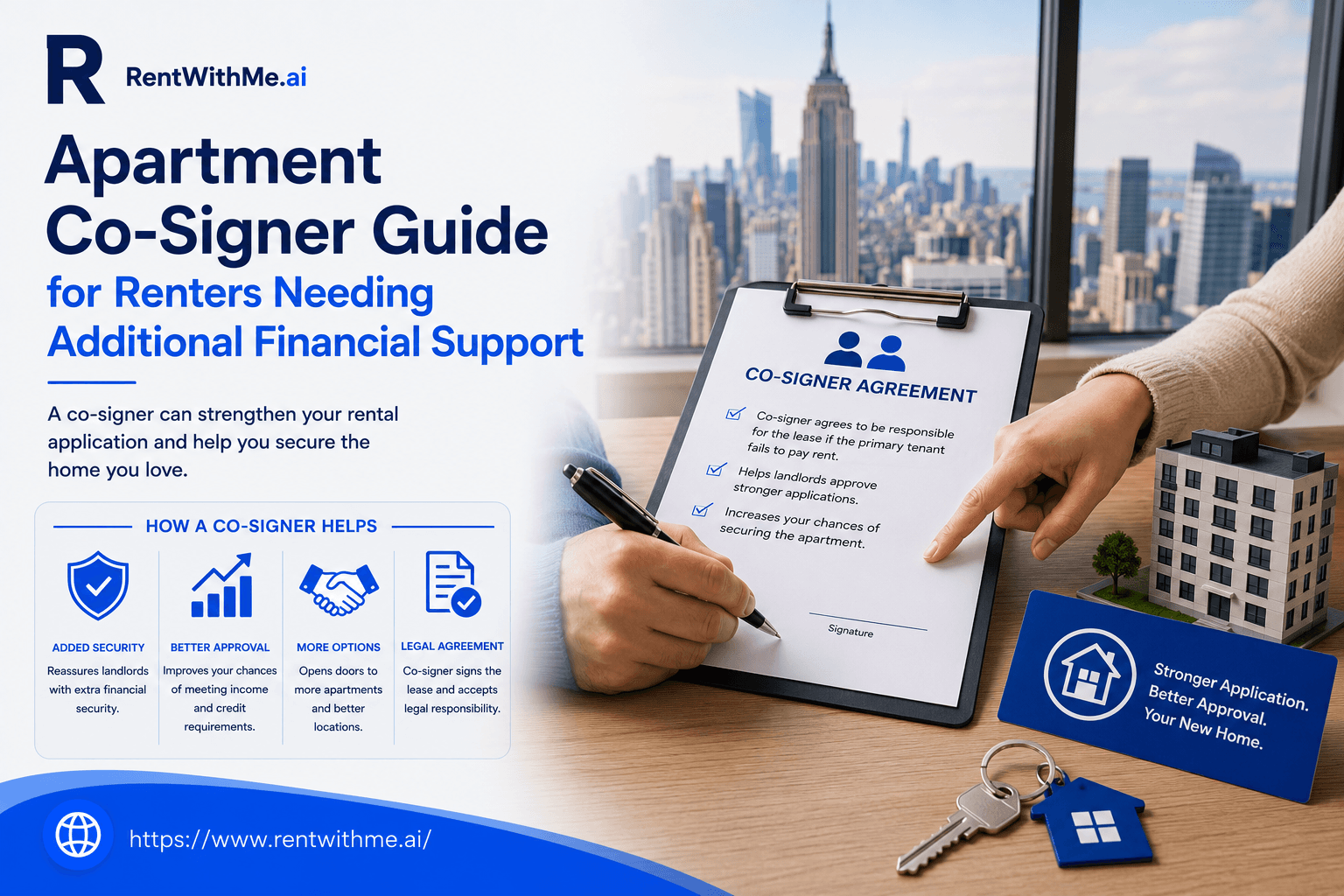
An apartment co-signer is an individual who signs the lease alongside the primary renter and agrees to share legal and financial responsibility for the rental agreement.
Although the primary tenant usually occupies the apartment, the co-signer agrees to help satisfy the lease obligations if the tenant cannot meet them. This arrangement provides landlords with additional financial assurance during the approval process.
A co-signer does not necessarily live in the apartment. Their primary role is to strengthen the rental application by demonstrating that another financially qualified individual stands behind the lease.
Landlords often use co-signers to reduce financial uncertainty when applicants have limited income, insufficient credit history, or other financial circumstances that require additional support.

Co-Signer vs Guarantor: Understanding the Difference
Many renters use the terms “co-signer” and “guarantor” interchangeably, but they may have different meanings depending on the lease agreement and the landlord’s policies.
In many rental situations, both provide financial support for the applicant. However, a co-signer generally signs the lease agreement and accepts legal responsibility under its terms, while a guarantor typically agrees to fulfill financial obligations if the tenant defaults, according to the guaranty agreement.
Because legal definitions and responsibilities vary, applicants should carefully review every lease document before signing. If any terms are unclear, asking the landlord or obtaining appropriate legal guidance can help avoid misunderstandings.
Rather than focusing on the terminology alone, renters should understand the actual responsibilities described in the lease and any supporting agreements.
Why Landlords May Require a Co-Signer
Landlords want confidence that rent will be paid consistently throughout the lease period. When an applicant does not fully meet the property’s qualification standards, requesting a co-signer provides additional financial security.
This does not necessarily mean the applicant is financially irresponsible. Instead, landlords use co-signers to reduce potential risk while still giving applicants an opportunity to qualify for the apartment.
In competitive rental markets, standardized qualification policies help landlords evaluate applications fairly. A co-signer allows applicants with unique financial situations to satisfy those policies without automatically being denied.
From the landlord’s perspective, a co-signer helps strengthen the overall financial profile presented during tenant screening.

Common Situations When Renters Need a Co-Signer
There are many legitimate reasons why a renter may need additional financial support during the application process.
Needing a co-signer is especially common among renters who are still building their financial history or experiencing major life transitions.
Some common situations include:
- First-time renters with limited rental history.
- Recent college graduates beginning their careers.
- Applicants with limited credit history.
- Renters rebuilding their credit.
- Self-employed individuals with variable income.
- Applicants whose income falls below the property’s requirements.
- Individuals relocating to a new city or country.
These situations do not automatically prevent apartment approval. Instead, they simply indicate that additional financial assurance may help strengthen the application.
How a Co-Signer Strengthens a Rental Application
A co-signer helps improve an apartment application by adding another financially qualified individual to the lease.
When landlords evaluate rental applications, they often look at the complete financial picture rather than focusing on only one qualification. A strong co-signer may provide confidence that lease obligations will be fulfilled if unexpected financial difficulties arise.
For applicants with limited credit history or lower income, a co-signer can make the application more competitive. This additional financial support may allow landlords to consider applicants they might otherwise hesitate to approve.
A co-signer should not be viewed as replacing responsible financial management. Instead, they serve as an added layer of security that supports the tenant’s application.

Financial Qualifications Landlords Typically Expect From a Co-Signer
Every landlord establishes their own qualification standards, but most expect co-signers to demonstrate strong financial stability.
Property managers usually review income, employment, credit history, and overall financial responsibility before accepting a co-signer. The objective is to ensure the individual has the financial capacity to fulfill lease obligations if necessary.
The following table summarizes several qualifications landlords commonly review.
| Financial Qualification | Why It Matters |
|---|---|
| Stable income | Demonstrates ability to support lease obligations |
| Employment verification | Confirms reliable earnings |
| Strong credit history | Shows responsible financial management |
| Proof of income | Verifies reported earnings |
| Financial documentation | Supports the application review |
| Overall financial stability | Reduces perceived rental risk |
Applicants should remember that qualification standards differ from one property to another. Reviewing the landlord’s requirements before applying helps ensure the chosen co-signer satisfies the property’s expectations.
Documents a Co-Signer Usually Needs to Provide
Like the primary applicant, a co-signer is generally required to submit documentation that verifies their financial qualifications.
Providing complete and organized paperwork allows landlords to review the application more efficiently and reduces unnecessary delays.
Common documents requested from co-signers include:
- Government-issued photo identification.
- Recent pay stubs or proof of income.
- Employment verification letter.
- Recent tax returns when requested.
- Bank statements if applicable.
- Credit authorization forms.
- Completed co-signer application.
Preparing these documents before beginning the apartment search helps both the applicant and the co-signer respond quickly when the right rental opportunity becomes available.

Common Misconceptions About Apartment Co-Signers
Many renters misunderstand how co-signers work, leading to unnecessary confusion during the apartment application process.
One common misconception is that a co-signer automatically becomes another resident of the apartment. In most cases, the co-signer simply accepts legal and financial responsibilities described in the lease without living in the unit.
Another misunderstanding is that only parents can serve as co-signers. Depending on the landlord’s policies, another financially qualified individual may also be eligible if they meet the property’s requirements.
Some applicants also believe that every landlord follows identical co-signer standards. In reality, qualification requirements vary significantly between property owners and management companies.
Understanding these misconceptions helps renters approach the application process with realistic expectations. In the next section, we’ll explore how the co-signer approval process works, what landlords evaluate when reviewing a co-signer, the differences between family members and friends serving as co-signers, the responsibilities and risks involved, alternatives if you cannot find a co-signer, common mistakes to avoid, what happens after approval, and the additional factors landlords consider before making a final leasing decision.
How the Apartment Co-Signer Approval Process Works
Once a landlord determines that an applicant needs a co-signer, the rental application moves into an additional review stage. Although procedures vary from one property to another, the overall process is generally similar.
The co-signer is asked to complete an application and provide documentation that verifies their financial qualifications. This allows the landlord to evaluate whether the co-signer satisfies the property’s approval standards.
Most landlords review income, employment, credit history, and identification before approving a co-signer. Some may also request additional financial documentation depending on the property’s leasing policies.
The following steps outline how the process typically works:
- The landlord notifies the applicant that a co-signer is required.
- The co-signer completes the required application forms.
- Financial documents and identification are submitted for review.
- The landlord evaluates the co-signer’s qualifications alongside the primary applicant’s information.
- If approved, both the applicant and co-signer sign the required lease documents before the lease is finalized.
Preparing all required documents before applying can significantly reduce delays. When both parties respond quickly to requests, the approval process often moves much more efficiently.

What Landlords Look for When Evaluating a Co-Signer
A co-signer is expected to provide additional financial confidence for the landlord. As a result, landlords carefully evaluate the co-signer’s ability to fulfill lease obligations if necessary.
Stable employment is one of the first factors landlords typically review. Consistent income demonstrates that the co-signer has reliable financial resources available throughout the lease period.
Credit history also plays an important role. A strong record of responsible borrowing and timely payments often strengthens the landlord’s confidence in the application.
In addition, landlords may review debt obligations, overall financial stability, and the consistency of the documentation provided. Their goal is to ensure the co-signer has the financial capacity to support the lease if unexpected circumstances arise.
Family Member vs Friend as a Co-Signer
Many renters naturally turn to parents or close relatives when they need a co-signer, but they are not always the only option.
Family members are frequently chosen because they often understand the applicant’s financial situation and may already be willing to provide assistance. Parents commonly co-sign leases for students, recent graduates, and first-time renters.
Some landlords also allow friends to serve as co-signers if they meet the required financial qualifications. In these cases, the relationship itself is generally less important than the individual’s ability to satisfy the property’s approval standards.
Regardless of who serves as the co-signer, landlords primarily focus on financial qualifications rather than personal relationships. The selected individual must demonstrate that they meet the property’s income, employment, and credit expectations.
Responsibilities and Risks of Being a Co-Signer
Agreeing to become a co-signer is a significant legal and financial commitment. Anyone considering this role should understand the responsibilities before signing a lease agreement.
If the tenant consistently pays rent and fulfills all lease obligations, the co-signer may never need to take any action beyond signing the required documents. However, if the tenant fails to meet certain financial responsibilities under the lease, the co-signer may also become responsible according to the agreement and applicable law.
Because of this potential responsibility, co-signers should carefully review every lease document before signing. Understanding the agreement protects both the renter and the co-signer from future misunderstandings.
Open communication between both parties is equally important. Discussing expectations before signing helps everyone understand their respective responsibilities throughout the lease term.

Alternatives if You Cannot Find a Co-Signer
Not every renter has access to someone who can serve as a co-signer. Fortunately, depending on the landlord and property, there may be other ways to strengthen an apartment application.
Some landlords are willing to evaluate additional financial documentation that demonstrates stability. Others may accept alternative qualification methods that reduce the need for a traditional co-signer.
Possible alternatives include:
- Providing stronger proof of income.
- Demonstrating substantial savings or financial reserves.
- Supplying excellent rental references.
- Showing consistent long-term employment.
- Using an approved professional guarantor service where accepted.
- Applying for apartments whose qualification standards better match your financial profile.
Applicants should discuss available options with the leasing office before submitting an application. Understanding a property’s flexibility can help avoid unnecessary application fees and improve the overall apartment search experience.
Common Mistakes Applicants Make When Using a Co-Signer
Even when applicants have access to a qualified co-signer, avoidable mistakes can complicate the approval process.
One common mistake is waiting until the last minute to ask someone to co-sign the lease. A co-signer needs sufficient time to review the commitment, gather financial documents, and complete the required paperwork.
Another frequent issue is submitting incomplete or outdated documentation. Missing pay stubs, unsigned forms, expired identification, or inconsistent financial information often delay landlord reviews.
Applicants also sometimes assume that every landlord follows identical co-signer policies. Because qualification standards vary widely, verifying the property’s requirements before applying is always a good practice.
Maintaining clear communication between the applicant, co-signer, and landlord helps prevent confusion and allows the review process to move more smoothly.
What Happens After a Co-Signer Is Approved
Once both the applicant and the co-signer satisfy the landlord’s requirements, the rental application typically enters its final stage.
The landlord prepares the lease documents and any additional agreements requiring signatures from both parties. These documents outline the rights and responsibilities associated with the rental arrangement.
After all paperwork has been completed, the landlord usually collects any required deposits, confirms the lease start date, and coordinates the move-in process.
Although approval is an exciting milestone, both the renter and the co-signer should carefully review every document before signing. Understanding the lease terms helps prevent future misunderstandings and ensures everyone clearly understands their responsibilities.

Additional Factors That Influence Rental Approval
Even with a financially qualified co-signer, landlords generally evaluate the complete application before making a final decision.
Every piece of financial and personal information contributes to the landlord’s overall assessment of the applicant.
The table below summarizes several additional factors that commonly influence rental approval.
| Approval Factor | Why It Matters |
|---|---|
| Verified income | Demonstrates ability to afford monthly rent |
| Employment stability | Indicates consistent future earnings |
| Credit history | Reflects financial responsibility |
| Rental references | Shows previous tenant performance |
| Complete application | Speeds up the review process |
| Professional communication | Builds confidence throughout the application |
A co-signer strengthens an application, but it is only one component of the overall approval process. Landlords generally consider income, employment, rental history, financial documentation, and the completeness of the application before making their final leasing decision.
In the final part of this guide, we’ll explore real-life examples of renters who successfully secured apartments with the help of a co-signer, answer frequently asked questions, provide a complete co-signer preparation checklist, share expert strategies for improving your chances of approval, discuss common co-signer mistakes to avoid, explore additional ways to strengthen your rental application, and conclude with practical advice for renters seeking additional financial support.
Real-Life Examples of Apartment Applicants Using a Co-Signer
Every apartment application is unique, and landlords evaluate applicants based on a combination of financial factors. The following examples illustrate situations where a co-signer helped strengthen an application. These scenarios are hypothetical and intended for educational purposes rather than guaranteeing rental approval.
Recent College Graduate
A recent graduate accepts their first full-time job in New York City and begins searching for an apartment. Although they have a steady income, they have limited credit history and no previous rental experience.
The landlord requests a co-signer to strengthen the application. The applicant’s parent meets the property’s financial qualifications, signs the lease as a co-signer, and the application is approved.
Young Professional With Limited Credit
A marketing specialist has maintained stable employment for more than a year but only recently began building their credit history.
While the applicant’s income satisfies the landlord’s requirements, the limited credit history leads the landlord to request a co-signer. A financially qualified sibling agrees to co-sign the lease, helping complete the approval process.
Self-Employed Freelancer
A freelance web designer earns a strong annual income, but monthly earnings fluctuate due to project-based work.
To provide additional financial confidence, the applicant submits tax returns, bank statements, and applies with a qualified co-signer. The combination of financial documentation and the co-signer strengthens the overall application.
Applicant Relocating to New York
An experienced professional relocates from another state after accepting a new position with a large company.
Although the applicant has stable employment, they have no local rental history. The landlord approves the application after reviewing both the applicant’s financial documents and a qualified co-signer’s information.
These examples demonstrate that a co-signer often serves as one part of a larger financial picture. Well-prepared documentation, stable income, and responsible financial behavior continue to play major roles throughout the approval process.
Frequently Asked Questions About Apartment Co-Signers
Apartment applicants often have similar questions when deciding whether a co-signer is necessary. Understanding these answers helps reduce uncertainty before beginning the rental process.
Does a co-signer have to live in the apartment?
In many situations, no.
A co-signer generally accepts legal and financial responsibilities outlined in the lease without occupying the apartment. The exact arrangement depends on the lease agreement and the landlord’s policies.
Can a friend be a co-signer?
Some landlords accept friends as co-signers if they satisfy the property’s financial qualifications.
Others may limit co-signers to family members or apply additional requirements. Applicants should verify the property’s policies before submitting an application.
Can I remove my co-signer later?
Whether a co-signer can be removed depends on the lease agreement and the landlord’s approval process.
Some landlords may allow changes under certain circumstances, while others require the co-signer to remain responsible until the lease expires.
Will having a co-signer guarantee apartment approval?
No.
A co-signer strengthens an application but does not guarantee approval. Landlords still review income, employment, credit history, rental references, and the overall strength of the application.
Is a co-signer responsible if rent is not paid?
The responsibilities depend on the signed lease agreement and applicable law.
Anyone considering becoming a co-signer should carefully review all lease documents before signing.
Complete Co-Signer Preparation Checklist
Preparing before apartment hunting helps both the applicant and the co-signer avoid unnecessary delays.
Use this checklist before submitting your rental application.
- Confirm whether the property accepts co-signers.
- Choose a financially qualified co-signer.
- Discuss responsibilities before applying.
- Gather government-issued identification.
- Prepare recent proof of income.
- Obtain employment verification.
- Organize tax returns if requested.
- Review credit information when appropriate.
- Complete all required application forms.
- Keep digital and printed copies of important documents.
Completing these steps early allows both parties to respond quickly when the ideal apartment becomes available. Organized documentation also helps landlords review applications more efficiently.
Expert Tips for Getting Apartment Approval With a Co-Signer
Planning ahead gives applicants a significant advantage in competitive rental markets.
Begin discussing co-signing arrangements well before submitting apartment applications. This gives the co-signer enough time to understand the commitment and prepare the necessary financial documents.
Submit complete and accurate information from the beginning. Missing paperwork often delays approval and can reduce your competitiveness when multiple applicants are interested in the same apartment.
Maintain clear communication with both your co-signer and the leasing office throughout the process. Responding promptly to questions demonstrates professionalism and helps landlords complete their review more efficiently.
Finally, apply for apartments that realistically match your financial qualifications. Even with a co-signer, choosing properties that fit your overall financial profile increases your likelihood of approval.
Common Co-Signer Mistakes to Avoid
Applicants and co-signers sometimes create unnecessary obstacles by overlooking important details during the rental process.
Understanding these common mistakes helps everyone prepare more effectively.
| Common Mistake | Better Approach |
|---|---|
| Waiting until the last minute to find a co-signer | Discuss co-signing before apartment hunting |
| Choosing someone who does not meet financial qualifications | Verify requirements before applying |
| Submitting incomplete documentation | Prepare all paperwork in advance |
| Assuming every landlord follows the same policies | Review each property’s leasing requirements |
| Not reading the lease carefully | Understand every responsibility before signing |
| Delaying responses to landlord requests | Reply promptly with complete information |
Avoiding these mistakes often leads to a smoother application process. Careful preparation demonstrates responsibility and creates a stronger impression with landlords and property managers.
Additional Ways to Strengthen Your Rental Application
A co-signer can significantly strengthen an apartment application, but additional preparation further improves your chances of approval.
Providing consistent proof of income, maintaining stable employment, and supplying positive rental references all contribute to a stronger financial profile. These factors help landlords evaluate your ability to meet your lease obligations over time.
Applicants should also ensure every document is current, accurate, and professionally organized. Well-prepared paperwork reduces questions during the review process and demonstrates attention to detail.
Professional communication is equally valuable. Prompt replies, honesty throughout the application, and courteous interactions with leasing staff help establish trust before the lease is signed.
Final Advice for Renters Who Need Additional Financial Support
Needing a co-signer should not discourage you from pursuing your ideal apartment. Many renters successfully secure housing every year with the support of a financially qualified co-signer.
The key is preparation. Understanding the property’s requirements, selecting an appropriate co-signer, organizing documentation, and communicating clearly throughout the application process all contribute to a stronger rental application.
Keep in mind that every landlord evaluates applicants differently. Some place greater emphasis on income, while others focus on employment history, credit, rental references, or the overall financial profile. Presenting complete and accurate information allows landlords to make informed decisions.
Whether you are renting your first apartment, relocating for work, returning to school, or rebuilding your financial history, taking time to prepare gives you the best opportunity to navigate the rental process successfully.
Conclusion
An apartment co-signer can provide valuable financial support for renters who need additional assistance meeting a property’s qualification requirements. Rather than viewing a co-signer as a sign of financial weakness, landlords often see it as a practical way to reduce risk while allowing qualified applicants to move forward with the leasing process.
There are many situations where a co-signer can make a meaningful difference. First-time renters, recent graduates, applicants with limited credit history, self-employed professionals, and individuals relocating to a new city frequently use co-signers to strengthen their rental applications. In many cases, the need for a co-signer reflects a limited financial history rather than an inability to afford the apartment.
Understanding how the co-signer process works allows applicants to prepare before they begin apartment hunting. Choosing a financially qualified co-signer, organizing documentation, reviewing lease terms, and maintaining open communication with the landlord all contribute to a smoother approval experience.
Anyone considering becoming a co-signer should carefully evaluate the responsibilities involved. Signing a lease as a co-signer creates legal and financial obligations that should be fully understood before any documents are executed. Reading every agreement carefully and asking questions whenever necessary helps protect both the renter and the co-signer.
Although a co-signer can significantly improve an apartment application, it is only one component of the overall approval process. Landlords continue to review income, employment stability, credit history, rental references, and the completeness of the application before making a final decision.
Ultimately, successful apartment approval comes from preparation, organization, and presenting a complete financial profile. By understanding the role of a co-signer, selecting the right person, and submitting a thorough application, renters can confidently navigate competitive rental markets and improve their chances of securing an apartment that meets their needs and long-term goals.